


Dr. Seuss gave us Thing One and Thing Two: identical-looking characters with very different jobs. That’s the idea here.
There are two very different ways to make information machine-readable. One helps a machine identify what’s on a page. The other helps it understand what’s actually being said.
Those are not the same thing. And new research suggests the distinction matters for AI citations.
What is Thing One?
Thing One is schema markup, often implemented using JSON-LD: structured information added to a webpage that machines can read.
Think of the tag sewn inside a shirt collar. A shopper never sees it, but it tells a scanner at checkout what the shirt is. Schema is that tag, for a webpage.
It has a real job: telling a search engine like Google what’s on a page, a product, a price, an event, a person, an organization, so Google can build a result.
That’s legitimate. It’s just not the job this piece is testing.
What is Thing Two?
Thing Two is the words on the page, organized clearly: clear headers, one idea per paragraph, the source of a fact sitting next to the fact, a real question answered directly.
No hidden notes, no code to interpret. Just information a person could read and understand right away.
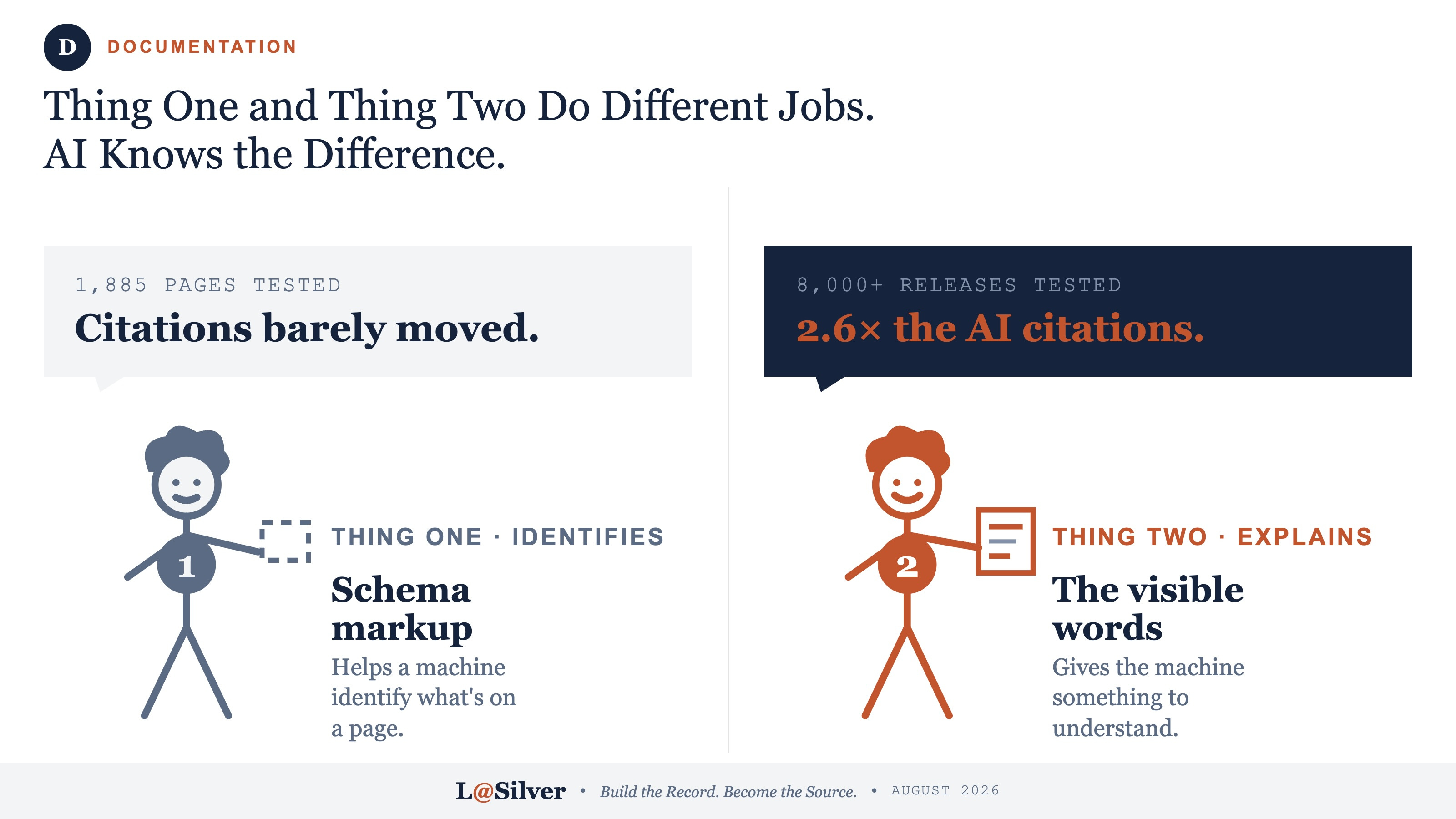
Thing One identifies. Thing Two explains.
We’ve been talking about “machine-readable” as a technical problem. AI adds another question: can the machine actually understand what you’re saying well enough to use it?
What does “getting cited” actually mean?
Ask ChatGPT a question, and sometimes it names a company, person, or article as where it got the answer. That’s a citation, the AI version of a reporter naming a source instead of using the quote without credit.
More citations mean more people hearing your name, or company name, from a tool they already trust.
So does Thing One also earn citations?
The data doesn't show that schema earns more AI citations.
Ahrefs, an SEO research company, added Thing One, schema, to 1,885 real webpages and tracked citations for a month afterward. Citations barely moved. On Google’s AI Overviews, they actually dropped.
SearchVIU tested it from the other side. They built several versions of the same product page, some showing the price in plain visible text, others hiding it only in code, JSON-LD, with nothing visible anywhere. AI tools found the price wherever it was visible. In their tests, they didn’t find it where it existed only in hidden code.
Now look at Thing Two. Notified analyzed more than 8,000 GlobeNewswire press releases and found that 99.3% were cited by ChatGPT or Claude. The average time to first citation was just eight hours, and well-structured releases generated 2.6 times more citations on average.
Thing One helps AI identify the page. Thing Two gives it something it can actually use.
So should you drop schema?
No. Keep it. It’s still doing its own job, and Google still reads it.
What actually earns the citation, then?
The question isn’t “is my site machine-readable?” It’s “is my expertise understandable enough for a machine to use?”
Write like you’re explaining something to a person, because you are. Say the source and number in the same sentence. Answer the real question your reader, or an AI, is asking, including in your headers. Make the claim, context, evidence and attribution easy to connect.
AI doesn’t just need to find your information. It needs to understand it well enough to reuse it.
What it means for the RECORD:
Documentation has two jobs: one helps a search engine identify what’s on a page; the other helps a person, and increasingly AI, understand what’s actually being said.
The web taught us to document for indexing. AI is forcing us to document for understanding.
I’m going through my own site against this split right now, as part of the audit I’ve been running on myself in public all summer. I’m not sharing what I found yet. That’s coming.
This newsletter, for what it’s worth, is built like Thing Two on purpose: real headers, the source next to the number, one idea per paragraph, no hidden information you have to decode. That’s what Thing Two buys you: understanding.
Thing One isn’t the villain.
Thing Two isn’t the replacement.
They just have different jobs.
Build the Record. Become the Source.
_________________________________________________________
Sources
We Tracked 1,885 Pages Adding Schema. AI Citations Barely Moved. — Ahrefs, May 11, 2026
Schema Markup and AI in 2025: What ChatGPT, Claude, Perplexity & Gemini Really See — SearchVIU, Dec 2, 2025
PR News | The Press Release’s Role in the Age of AI Answers — Erik Carlson, CEO of Notified, via O’Dwyer PR, Aug 26, 2026
Schema Markup Adoption: 5,000-Site Audit and Findings — Digital Applied, Apr 26, 2026