


In my last piece I outlined why PR is having its Moneyball moment. Earned media, the work we could never quite prove, turns out to be exactly what AI trusts. The market mispriced us. Now the correction is underway, and it’s showing up in the data faster than most teams are moving.
First, the numbers, because they’ve gotten sharper.
Start with the ownership gap.
Muck Rack surveyed 1,115 PR pros for its State of PR 2026 report.
73% call AI search visibility important to their strategy.
29% say no one owns it.
39% aren’t measuring it at all.
Everyone sees the shift. Almost nobody has a playbook.
Now the search data. People ask, AI answers, nobody visits your site.
68% of U.S. Google searches ended without a click in early 2026, up from 60% in 2024 (SparkToro’sSimilarweb analysis 2026).
Here’s the part that should reorganize your budget.
When Muck Rack’s research team analyzed 25 million links cited by ChatGPT, Claude, and Gemini this spring, 84% were earned media.
Paid and advertorial content? 0.3%. You cannot buy your way into the answer.
The answer is earned.
Earned. That’s our word. This moment belongs to PR, if we show up for it.
One more thing before the system. Most PR teams are meeting this moment with efficiency questions. Draft faster, cut hours, do yesterday’s work more cheaply. Fine, but small. Efficiency improves what already exists. The bigger question is what’s possible now that wasn’t possible before.
For PR, the answer should thrill you. Becoming the source AI cites was impossible two years ago. It’s buildable today, with skills we already have. We’ve spent decades proving our value with metrics nobody trusted. Finally, the game favors our work.
Here’s how.
The core idea
AI doesn’t rank you. It remembers you.
Everything published by you and about you is the record it learns from. Thin record, thin answers. Wrong record, wrong answers. Strong record, and you get recommended by name.
I’ve lived this. Two months ago I asked five AI platforms to describe Vinebox. Most got the basics right. Not one mentioned corporate gifting, the entire B2B strategy we were building. The record was thin exactly where it mattered most, and that gap became the foundation of our go-to-market plan. RECORD is what I built from that lesson.
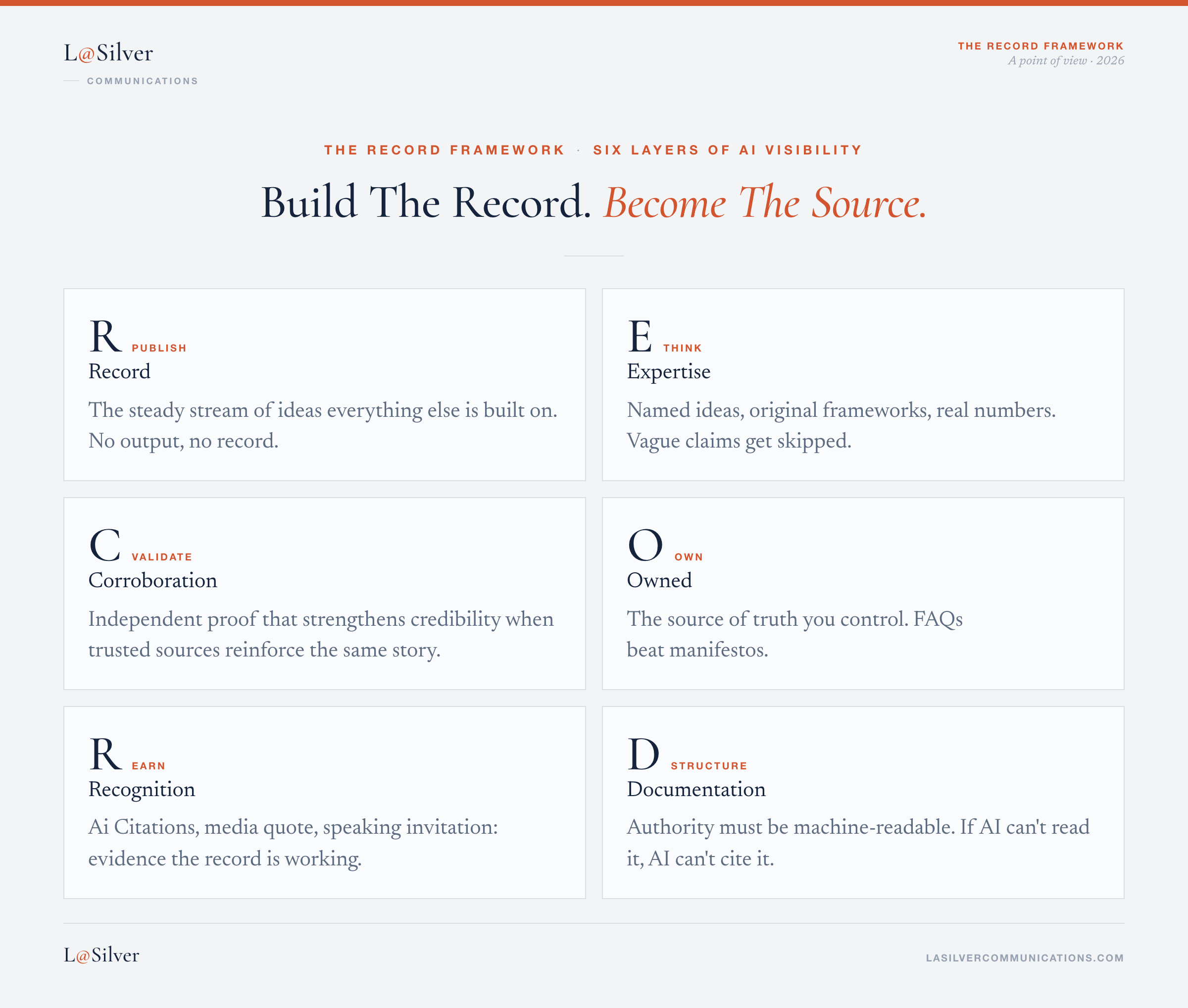
Authority isn’t built through campaigns. It compounds. The RECORD Framework is a six-layer system for building authority AI can find and cite: Record, Expertise, Corroboration, Owned, Recognition, Documentation. Each layer strengthens the next. For each, here’s the idea and one free thing to do this week.
R is for Record. Publish. The steady stream of ideas everything else is built on. No output, no record. One great article changes nothing. Fifty decent ones over two years change what AI says about you. This week: ask ChatGPT, Claude, and Perplexity what they know about you. Then pick a publishing schedule you can keep.
E is for Expertise. Think. AI rewards knowledge, not slogans. A named idea, an original framework, a perspective only you could have. And specificity wins: researchers at Princeton, the Allen Institute for AI, and IIT Delhi found in controlled tests that adding statistics, citations, and quotations improves AI visibility by up to 40%. Vague claims get skipped. This week: write down the one thing you know better than anyone. Put a number in it. Publish it.
C is for Corroboration. Validate. You can’t declare authority. Third parties do the vouching: journalists, analysts, customers. Machines weight independent proof the way people do, which is why that 84% matters. This is PR’s home turf. This week: ask AI which outlets it cites for your topics. Your media list just changed.
O is for Owned. Own. Your website is the source of truth AI triangulates back to. And it’s usually the boring content that surfaces. FAQs beat manifestos. This week: write down the ten questions customers actually ask. Answer them plainly on your own site.
R is for Recognition. Earn. The evidence the record is working: AI citations, media quotes, invitations. This is the layer you watch. It also catches what AI gets wrong, and wrong claims compound. This week: ask AI what your customers would ask. Fix what’s wrong at the source. Recheck monthly, same questions, same tools.
D is for Documentation. Structure. Authority must be machine-readable. If AI can’t parse it, AI can’t cite it. Sloppy structure means someone else gets credit for your thinking. This week: make your bio identical everywhere you publish. Cheapest fix in the framework.
What RECORD is not
It’s not a rival to the measurement standards this industry already has. RECORD lives upstream: I build what AI learns from, measurement proves whether it moved anything. You need both.
It’s not a certification or a tool. Every action above is free, on purpose. I’m an independent practitioner. Systems scale down. If you’re a solo consultant or a three-person shop, this was built at your size.
And it’s not a crisis tool. AI visibility is what you build before the crisis. When a reporter opens ChatGPT mid-story, the answer comes from your record or from your critics’. Decide which one you’re building now.
Start here
The full framework lives at lasilvercommunications.com/record-framework.html.
If you do one thing after reading this, ask an AI what it knows about you. Five minutes, and it’s the most honest performance review your program has had in years.
The record is the asset. Citations are just the box score. Start building.
If you’re building your record and want the next piece when it lands, subscribe below.
Sources:
Muck Rack, The State of PR 2026 (survey of 1,115 PR professionals)
Muck Rack, What Is AI Reading? (May 2026 edition, 25M+ links cited by ChatGPT, Claude, and Gemini)
SparkToro, analysis of Similarweb clickstream data (2026)
Adobe Digital Insights, AI-sourced traffic report (Q2 2026)
Aggarwal et al., GEO: Generative Engine Optimization (Princeton, Allen Institute for AI, IIT Delhi)