


I used to be a half-watcher. Glance at the score, see who won, call that the story.
Then I read what network scientists at Northeastern did with this summer’s World Cup, and I haven’t watched a match the same way since.
They’re not counting goals. They’re mapping identity. The goal is the announcement. The win happened long before it.
Most brands only show up for the announcement. There’s a moment in every match the highlight reel skips. Not the goal, but the eleven touches before it.
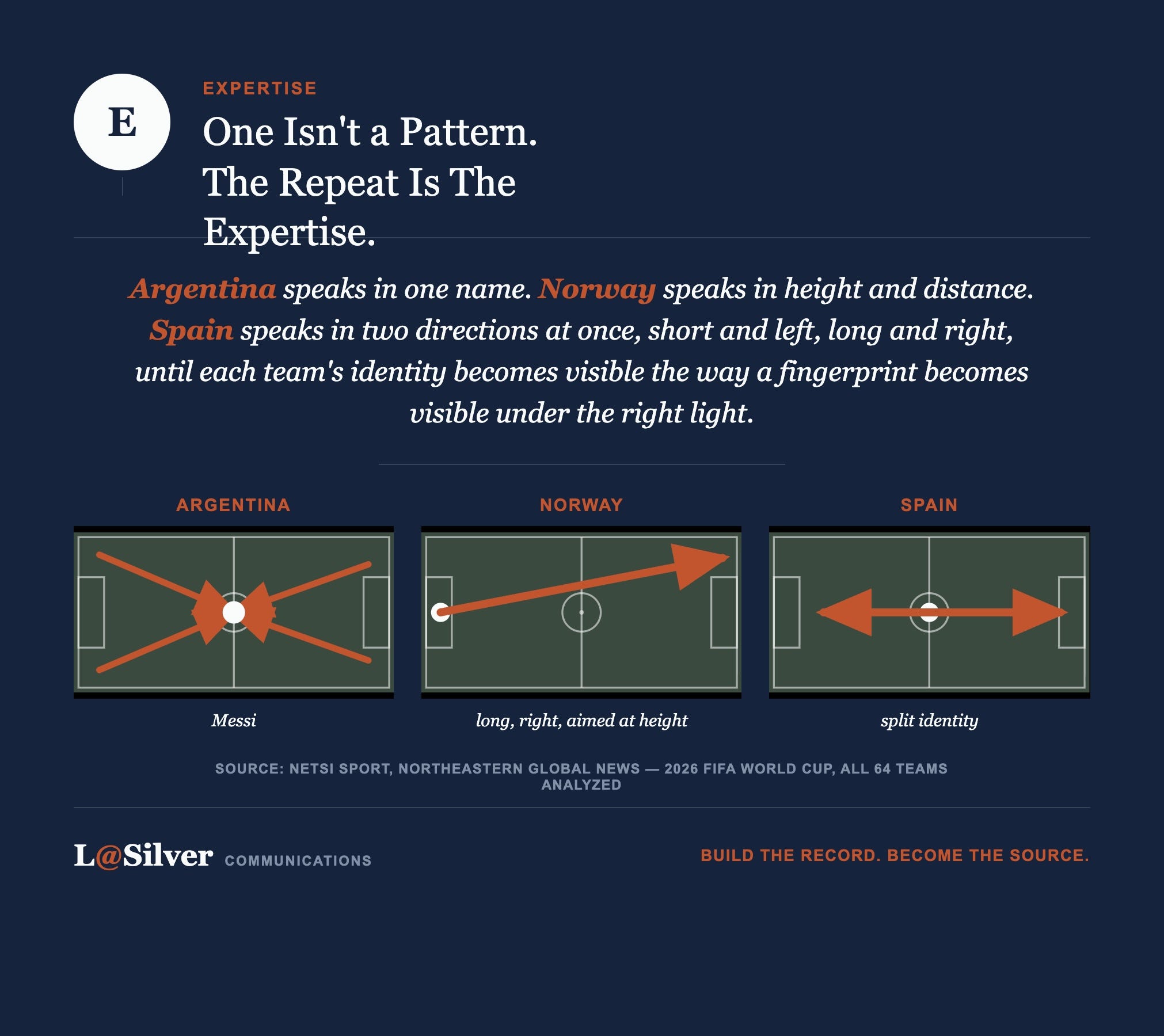
Argentina’s signature is built to find one man. Norway’s signature runs long and right, aimed at players tall enough to win it in the air. Spain’s signature splits in two directions at once, a short combination on the left and a long ball hunting an eighteen-year-old on the right. Northeastern’s NetSI Sport group mapped all 48 World Cup teams this way, tracking the five passing patterns each team ran more than expected, above the baseline every team shares.
That baseline is the part that struck me. Brennan Klein, who leads the research, said most passes in a match are the ones any team would make, formulaic, interchangeable, forgettable. What separates a team isn’t that it passes the ball. It’s the handful of patterns it runs again and again that no other team runs the same way.
That’s the part the RECORD Framework calls Expertise. Not the pass, not the game, but the thinking that shows up as a repeated deviation from what everyone else is doing, until it’s recognizable on sight. Spain’s split identity didn’t start this tournament. Argentina’s whole shape existing to find Messi didn’t start this tournament either. Both were built match after match, long before anyone outside the data was counting.
A forty-eight team World Cup means more teams arriving without an established shape yet. New entrants without a record. Everyone starts there. Norway didn’t invent its long-ball dependence on Haaland and Sørloth for this tournament. It built that signature, above the baseline, one match at a time.
The score is what happened in ninety minutes. The record is what was true the whole time underneath it. AI citation works the same way: it rewards the pattern, not the post.
Four things to take with you:
One isn’t a pattern. Authority shows up in what repeats above the baseline, not in what’s loud once.
The deviation gets recognized, not the moment. That’s why a record compounds and a campaign doesn’t.
Every new entrant starts without a record. The question is whether you’re patient enough to keep producing the work that lets one form.
AI reads the same signal. It's not indexing your best post, it's tracking whether the same idea keeps showing up.
This piece grew out of Northeastern Global News’ coverage of the 2026 World Cup, drawing on research from Northeastern's NetSI Sport group.
If you want to see where your own record stands, which layers are humming and which are quiet, the RECORD Framework is the place I’d start.