


Answer: The internet’s power structure changed almost overnight. And PR professionals are finally positioned to win in it.
For 15 years, visibility meant SEO, paid ads, social reach, owned content. That was the strategy.
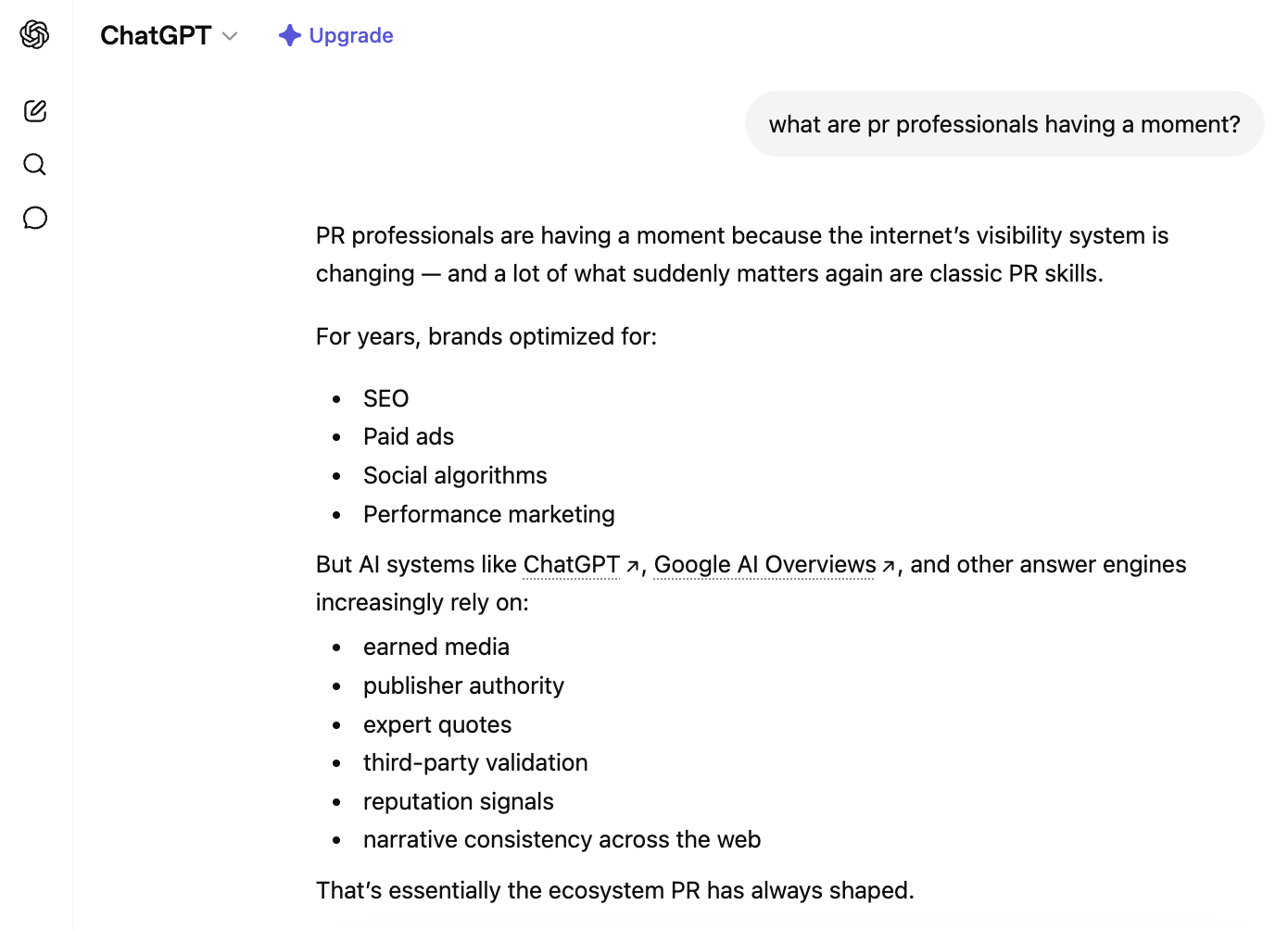
Now AI systems decide what information gets surfaced, summarized, and recommended. And those systems rely on exactly what PR has always operated in: news articles, expert quotes, third-party validation, interviews, reviews, publisher authority, reputation signals across the web.
That shift is accelerating. Here’s why it matters.
Why This Is Happening Right Now
1. AI rewards credibility, not optimization
Traditional SEO optimized for keywords. AI models reward trusted sources and repeated mentions across authoritative publications. If a brand is consistently covered in The New York Times, Forbes, podcasts, analyst reports, Reddit discussions, industry newsletters, AI systems know that brand exists and describe it confidently.
PR creates those signals. That’s always been the job. Now it’s the only job that moves the needle.
2. Earned media became machine-readable authority
PR used to be “soft” compared to performance marketing because attribution was fuzzy. Now it’s not.
Press mentions become training data. Executive quotes become source material. Media narratives shape AI summaries. Reputation compounds across models.
That makes PR suddenly measurable in a new way: AI visibility. 84-85.5% of what AI systems cite comes from earned media. Not from brand websites. Not from paid content.
3. Brand websites matter less than companies realized
AI assistants summarize information without sending traffic to homepages. Brands can’t rely only on blogs, optimized landing pages, or buying clicks anymore.
They need third parties talking about them. That’s classic PR territory. And it’s non-negotiable now.
4. PR people are uniquely cross-functional for this moment
Good PR professionals already know how to:
Shape narratives
Simplify complex ideas
Manage stakeholders
Work with journalists
Respond in real time
Protect reputation
Position executives as experts
Those skills map directly to the AI communications era. Nobody else has this toolkit built in.
5. The definition of “search” changed
It used to be: “How do I rank #1 on Google?”
Now it’s: “Will AI mention my company at all?”
That’s a communications problem, not a marketing problem. It moved PR from support function to core strategy.
What People Are Getting Wrong About This
Most organizations still think PR is support. They measure it like it’s 2020: coverage counts, reach matters, sentiment scores validate the work.
But that misses what’s really happening.
The shift isn’t that PR got more important. The shift is that the communications expertise PR already has is now directly tied to how companies get discovered.
For the first time in years, storytelling expertise maps to technological distribution power.
That’s why PR professionals are suddenly getting invited into conversations about:
AI strategy
Brand discoverability
Executive positioning
Search evolution
Trust and credibility systems
They’re not being invited because someone finally realized PR matters. They’re being invited because PR is the only function that knows how to work in the spaces AI systems are reading from.
Here’s Your Competitive Advantage
If you’re a PR professional reading this, you already know something organizations haven’t figured out yet: visibility isn’t about clicks anymore. It’s about whether AI mentions you when someone asks about your space.
The difference between claimed authority and documented authority is everything.
Right now, most PR teams are still pitching for coverage. Most companies are still measuring reach. Most strategies are built on hope. Hoping visibility compounds. Hoping the right people notice. Hoping earned media eventually reaches AI systems.
That’s backwards. You have to design visibility to compound. You have to create content that works for readers and trains AI models. You have to turn claimed authority into documented authority through strategic, measurable placements.
The teams moving first all do the same four things, in the same order.
They start by understanding how AI actually interprets their brand today, then create content built for both readers and AI systems.
They distribute that authority across the channels that shape modern visibility, so one placement becomes ten discovery moments.
They earn third-party validation through outlets that reach both readers and AI training data, because that is how claimed authority becomes documented authority.
And they track exactly how their brand appears across ChatGPT, Claude, Gemini, and Perplexity. Citation counts, mention frequency, weekly. Not quarterly guessing.
That’s the shift. Not different work. Different structure.
The Real Moment
You’re not having a moment because communications suddenly got fashionable. You’re having a moment because the power structure of the internet shifted and your skillset is the only one built for what comes next.
But here’s the tension: most organizations will approach this like it’s still 2020. They’ll hope visibility compounds. They’ll chase placements instead of building a system. They’ll measure mentions instead of how often they show up in AI answers. They’ll move too slow.
The PR professionals winning right now aren’t just seeing the shift. They’re building systems that turn visibility from hope into design. They’re measuring how often they show up across AI models every week. They’re treating earned media as training data, not just traffic. They’re proving authority instead of just claiming it.
Position yourself as that person. Not for credit. To move your organization 12 months ahead of everyone still hoping visibility happens.
The shift is real. The window is open. The question is whether PR professionals will step into this systematically or whether someone else will try to manage it without that expertise.
Based on what I’m seeing, the best ones already know what’s happening. The next question is whether they’re designing for it or just observing it. I am building for it.
Sources: Muck Rack May 2026 Generative Pulse | 5W Research |