

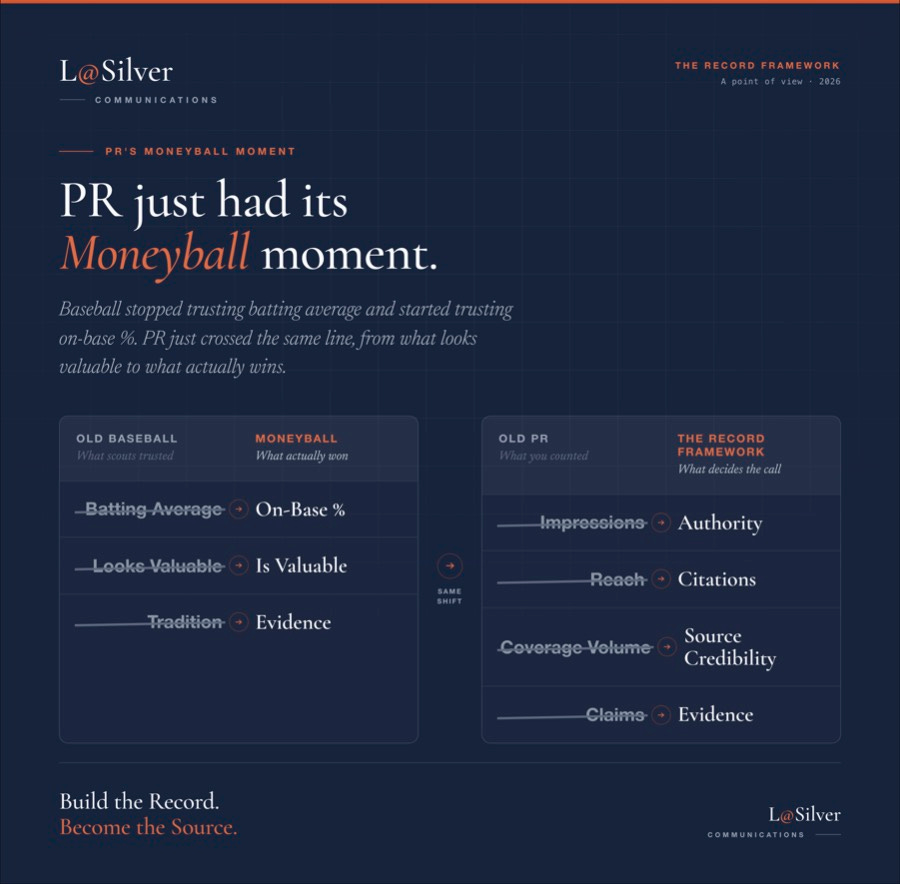
Baseball paid for batting average for decades. Then a few teams noticed on-base percentage predicted wins better, and nobody was pricing it yet. The teams that switched early beat teams with three times their payroll.
PR just crossed the same line.
On July 2, Visa and more than 30 European banks let AI agents complete real purchases at real merchants: lastminute.com, Frasers, Cleverbridge. Not a demo. AI isn’t just shaping opinions anymore. It’s starting to close sales.
The chain is real. So is the risk of overstating it. Comms builds the front end of it. What we can’t prove yet is the whole thing, one placement traced all the way to one sale. Here’s what we do know: the loop is closing. When it closes, the credit goes to the brands that built a record before it did. That’s the window, right now.
A handful of people have been evangelizing this shift long before this week’s news made it easy to see. Sarah Evans is one of the sharpest voices making the case that PR finally has receipts. She’s right that something is closing. Where I land is on what to do about it before it closes: build the record now, not after.
We’ve all felt this shift coming for a while. A placement that used to matter on its own now only matters if it connects to something bigger. Nobody had a name for that yet. So I built one.
For most of my career, the hardest part of being a publicist wasn’t landing the coverage. It was proving the coverage meant anything. I sat in year-end reviews holding impressions, reach, and coverage volume. Our batting average. Visible. Countable. Comfortable, right up until a CFO’s eyes glazed over, because we both knew those numbers measured what looks good, not what wins.
Buyers don’t start with Google anymore. They ask ChatGPT, Claude, Gemini, Perplexity, whatever ecosystem they’re comfortable using, to find them a brand and tell them it’s safe to trust. The answer isn’t a ranking of who spent the most on visibility. It’s a synthesis of who has the strongest record.
The new scoreboard
Impressions are out. Authority is in. Reach is out. Citations are in. Coverage volume is out. Source credibility is in. Claims are out. Evidence is in.
Everything on the left measures how loud you were. Everything on the right measures whether anyone, human or machine, has a reason to believe you.
Why campaigns stopped compounding
The old model treated authority like something you rent. Run a campaign, get a spike, watch it fade, run another. AI broke that model. It doesn’t remember your campaign. It remembers your record, the body of work attached to your name that’s out there, findable, and verified.
Here’s the thing. Earned media accounts for 84% of all AI citations across ChatGPT, Claude, and Gemini. Paid content accounts for 0.3%. That number has held steady, within a few points, for a year straight. And when the same article gets picked up by third-party outlets instead of sitting only on a brand’s own site, AI citation rates jump 325%. Not because the writing got better. Because someone else vouched for it.
One great placement with nothing built around it fades. A placement that other sources keep pointing back to compounds.
The system for the new game
I’ve spent 25 years helping companies build credibility, trust, and loyalty via earned media. When the scoreboard changed, most of the industry responded by making more content. That’s not wrong, exactly. It’s just not enough on its own. What was missing was a roadmap: what to build first, what has to corroborate it, what makes it citable instead of just visible. RECORD is that name.
It’s called RECORD. Six layers: Record. Expertise. Corroboration. Owned. Recognition. Documentation. Yes, the first R stands for Record. That’s the whole point.
Skip a layer and the record leaks. Publish constantly with no structure and machines can’t see you. Nail the schema with nothing original to say and all you’ve documented is your own claims.
Next Wednesday I’ll break down all six layers: what each one is, why it earns citations, and the one question to ask about your own brand. Subscribe and it lands in your inbox.
The window
Brands building their record now are setting the patterns that will harden into defaults, the same way the first teams to use on-base percentage got years of advantage before everyone else caught up.
Moneyball was never about baseball. It was about what happens when the measure of value changes. The teams watching the wrong thing lost to the ones who adapted to the new game.
The scoreboard changed. RECORD is how you play the new game.
The full framework lives at lasilvercommunications.com. Start there if you want to know what AI says about you when a buyer asks who to trust in your category.
Build the Record. Become the Source.
____________________________________________________________________________
LeeAnn Silver is the founder of L@Silver Communications, a strategic communications firm helping brands become the source AI cites and buyers trust. The RECORD Framework is the foundation for building that authority.