


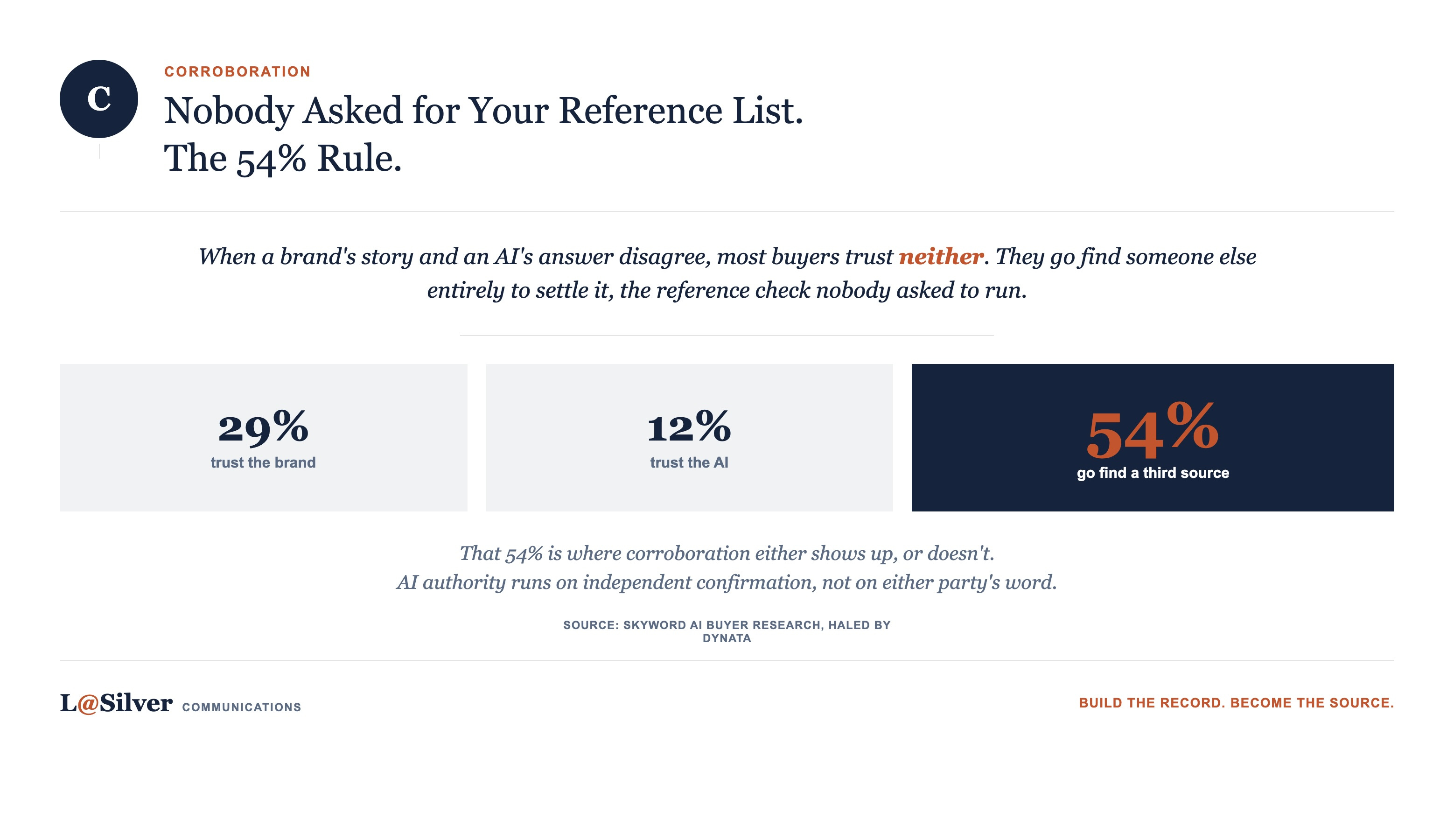
29% trust the brand. 12% trust the AI. And the other 54%? They go find someone else to settle it. Not the brand, not the chatbot. Someone else entirely.
Huh, right? I thought people would just pick a team. They don’t.
This is from Skyword’s AI Buyer Research. They asked 1,000 U.S. adults in April what they do when a company’s own website says one thing and an AI assistant says another. And most people basically go “nah, I don’t trust either of you, I’m doing my own digging.”
Which, honestly? Valid. I search for stuff to buy this way too.
Think about it like this. Say you ask ChatGPT to compare a company’s product to their competitor’s, and it doesn’t match what’s actually on the company’s site. Now you’ve got two different stories and zero reason to believe either one. So what do you do? You open a new tab. You go looking for someone who isn’t the brand and isn’t the AI.
That’s it. It’s just a reference check.
AI doesn’t just take the brand’s word for it, and there’s a simple reason why. A company describing itself is like a guy describing himself on a first date. Of course he says he’s great! Everybody does. AI knows that, so it goes and calls your references instead. Same thing a hiring manager does. Nobody hires someone off their own word alone. You call their old coworkers. And if those coworkers tell a different story? The manager doesn’t split the difference. They go find a fourth person.
That fourth person is your 54%.
In a real reference check, you hand over the names. You pick your three biggest fans, obviously. AI doesn’t ask permission for that. It just finds whoever’s already out there talking about you: a reporter, a customer, blogger or random analyst. You don’t get veto power. Whoever’s on record is the record.
So what actually counts as corroboration?
Corroboration just means someone with nothing to gain backs up your story. A journalist, a customer, an analyst, a peer. Unpaid, unprompted. It’s the reference check that kicks in the second your story and AI’s stop matching.
Without it? A buyer asks who founded your company and gets a competitor’s name. A prospect hears a product you stopped selling last year is still available. A journalist quotes pricing from two years ago. AI fills the gap with whatever’s out there. The buyer can’t tell who’s right, they just know two things disagree, so they go find a third. And if all they find is more stuff you wrote about yourself? You lose. By default.
One good article doesn’t fix this, either. One article is a data point. It’s not a pattern. Similarly, one glowing reference is just one former coworker who happened to like you. More and more data confirms AI authority comes from the same claim getting repeated, by different independent people, over and over. Old-school PR counted placements. This counts consistency.
Four things move the needle now, and they all do the same job:
1) Someone with zero incentive except honesty backing you up: earned media a reporter actually verified, not a press release with new formatting. 2) Analyst coverage, from people whose whole job is being skeptical. 3) Podcasts and guest bylines where someone else’s audience vouches for you. 4) Customer stories, told in the customer’s own words.
Skyword’s research backs this up from a totally different angle too: brand influence now flows through places you can guide but can’t fully control including publishers, analysts, review sites. This is exactly why one great placement isn’t the win. Consistency is.
Where this fits in RECORD
RECORD is my thesis and working framework for building earned trust. It’s how brands and people become discoverable through AI authority. PR, evidence, content, and trust meet here.
Most AI visibility tools tell you whether you appear. RECORD tells you whether you’re understood, and whether you’re worth citing.
It measures how likely AI systems are to see you as a trustworthy source, based on evidence vs. your own claims about yourself. Six layers: Record, Expertise, Corroboration, Owned, Recognition, Documentation.
Corroboration is the layer that answers exactly what this Skyword data is pointing at. When neither your word nor the AI’s answer is enough for a buyer, what actually is?
Bottom line
AI is running a reference check on your brand right now, and nobody sent it a list of who to call. Go ask ChatGPT or Claude who you are and what you do. Then check what comes back. Does it match what you’d actually say about yourself?
Wherever it doesn’t? That’s a reference you don’t control yet.
___________________________________________________________
Build the record. Become the source.Sources: Skyword AI Buyer Research; When AI Gets Brand Information Wrong, Consumers Look Beyond the Brand (Skyword, June 2026); How to Adapt Enterprise Content Strategy for the AI Search Era (Skyword).