

I audited my own firm, fixed what I could, ran the same audit again, and published what changed. Some numbers moved. The one I cared about most didn't.
The short version.
In July, I audited my own firm and scored zero.
Zero rankings across 62 searches. Zero citations out of 295 sources. Zero mentions. Zero share of the conversation.
I fixed what I could, ran the same audit again in September, and published whatever came back.
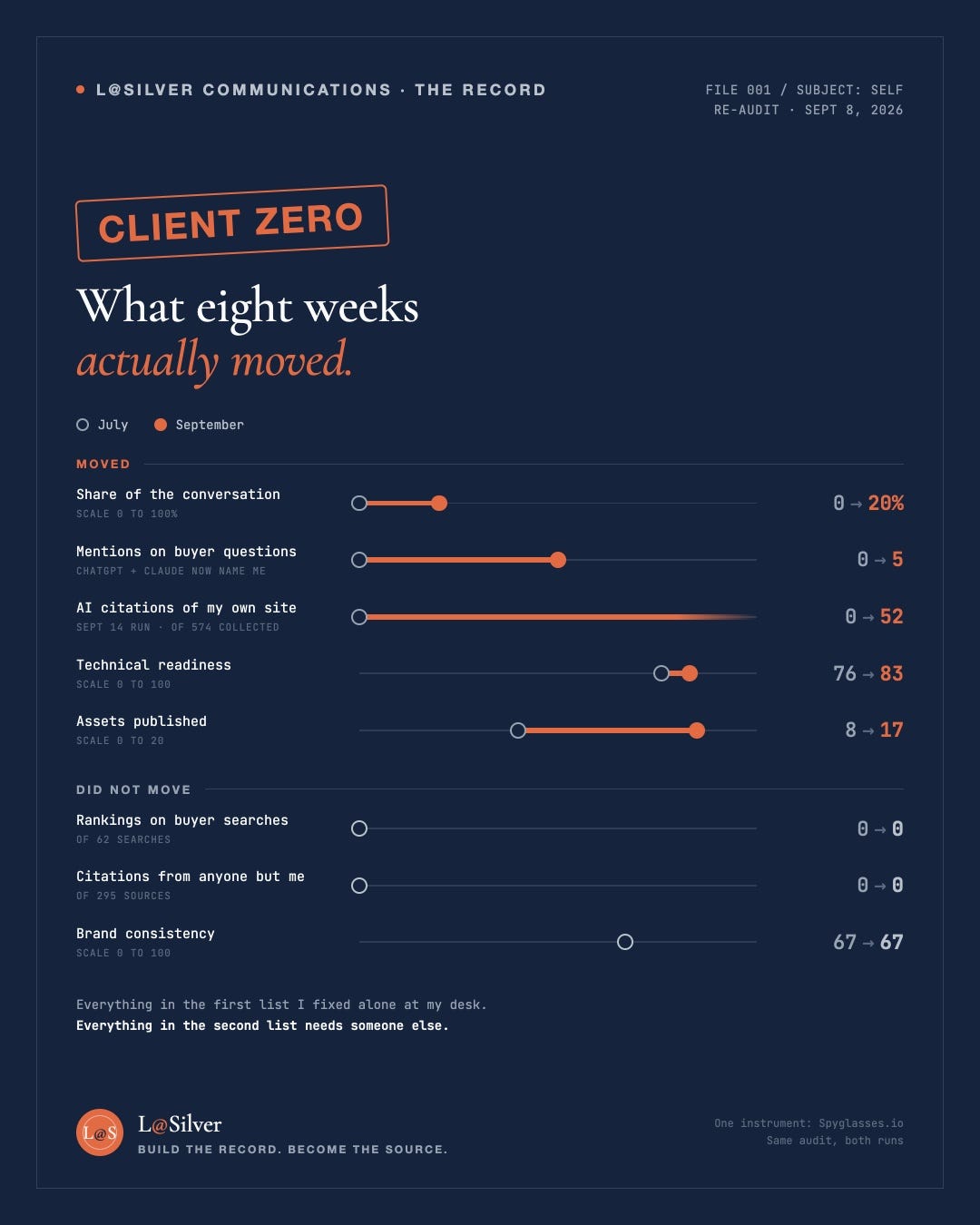
Some things moved. Share of the conversation went from zero to twenty percent. ChatGPT and Claude started mentioning me. My site was cited for the first time. Technical readiness improved from 76 to 83. Gemini and Google AI Overviews began pulling pages from my site.
But the part I cared about most didn’t move.
My site still ranked in zero buyer-type searches, and citations from anyone other than me were still effectively zero.
That became the most useful finding of the whole experiment.
So this isn't about going from zero to twenty percent.
Everything I could fix alone moved. The authority I need other people to create didn’t.
I also learned that an AI visibility number is only as good as the questions underneath it and what counts as a real change.
Two months of work changed what I could reach on my own. It didn’t touch what needs other people. That gap is where PR starts doing the work a website never can.
___________________________________________________________________________
Here's what I actually did, what moved, what didn't, and what I learned about measuring it.
My tool of record is Spyglasses.io, same platform for the July baseline and the September re-run, so the numbers below come from one instrument. They provided my access for this audit. I have not paid for it.
What moved
Share of the conversation went from zero to 20 percent. Mentions on buyer-type questions went from zero to five, and ChatGPT and Claude both name me now. In July neither did. AI cited my own site for the first time. Three times in the September 8 report, all ChatGPT. On September 14 the nightly run logged 52 citations to my site out of 574 it collected, and Gemini and Google AI Overviews were citing my pages too. The number was still moving while I wrote this. Technical readiness went 76 to 83.
What didn’t move
Citations from anyone other than me are still effectively zero. And searches where my site actually ranked went from zero in July to zero in September. Perplexity cited me once, on August 26, and hasn't since. Gemini and Google AI Overviews do pull pages from my site now, but every question they pulled them on named me or named RECORD. Whether any of those answers said my name out loud is the column Spyglasses is still fixing, so I'm not claiming it either way.
Everything I could fix alone moved
Look at those two lists again. Everything in the first one I did alone. Everything in the second one needs someone else to write about me, quote me, or link to me.
That line doesn’t fall between good work and bad work. It falls between the work you can finish alone and the work you can’t.
The fixable half is fast, cheap and mine. The other half runs on someone else’s calendar.
Is being findable by name the same as being discoverable?
No. In an August check my site did rank in six searches, which looked like progress until I read them. All six contained my own name or my framework’s name. Of course my site ranks for “RECORD framework.” That’s the machine confirming something it was already handed.
In September the audit asked five questions that never mentioned me, the kind a buyer would actually ask. My site ranked in zero of the 31 searches those questions produced.
Spyglasses agrees that searches containing my own name don’t belong in a visibility report, and has logged it as a bug. I’d rather report that than quietly drop the number.
I’m findable if you already know I exist. That’s a different business.
Something is naming me, and it’s mostly not my website
ChatGPT and Claude both put me in answers to category questions, while my site ranked in none of the searches they ran to build those answers. So the mention is coming from somewhere else. I didn’t earn it on my own site, and I still don’t know exactly where it came from. With one exception.
On September 8, ChatGPT answered, “Who specializes in AI visibility for founder-led brands?” by naming L@Silver Communications and linking to my homepage. The question never mentioned me. The answer named me and pointed at my own site. Once. It’s the closest thing to discovery in the whole audit. It described me as working in that category and using “PR, original research, bylines, and earned media to build the third-party authority that AI systems can cite.” That is my positioning, read off my own site and handed back to me. Which is what an owned page is for. It also means this is one receipt, not a trend.
I was listed alongside a local SEO firm, not on my own. A model can only use the pages that exist. On this subject, a lot of them were written by search firms. The gap isn't in the work. It's in the record of it.
That doesn’t cancel the zero. Ranking in a search and being cited in an answer are two different things. An AI can pull a page into its answer without that page ranking in the searches it ran, so both are true at once.
Can a visibility score carry a claim?
Not unless it can tell you what it sits on. Three things, two I only learned by asking Spyglasses directly and one they caught before I did.
The brand consistency score went 67 in July, 63 in August, 67 in September. I was ready to report a decline. There’s no defined threshold for what counts as a real change in that number, and four points sits inside the noise. I nearly published a drop that meant nothing.
And a report runs five questions, not the 47 I’d carefully built. Nobody hid that. I didn’t know to look.
And my framework is called RECORD. The platform was tracking the word record as one of my brand names, so answers that used the ordinary English word were counting as mentions of me. Jim Wrubel at Spyglasses found it in the raw responses and told me before I published. Real brand recommendations sit underneath it. Now I can tell which is which.
A second one was about my name itself. My brand name had an @ in it, and that character does strange things inside machine pipelines, so some of my mentions may have been landing under a different name entirely. On the one answer where ChatGPT named me correctly, @ and all, the platform’s read of my page came back as “Silver Communications,” which Spyglasses is still looking into. The @ now lives in the logo, and everywhere else the name is written out as LASilver Communications.
A mention count is only as good as the word it’s watching for. Mine was watching for a word people use every day.
If a number can’t tell you how many questions it sits on, or what size change is real, it can’t carry a claim. Mine included.
Which sources does AI actually cite in my category?
Across 90 days my instrument logged 1,391 citations in the answers it collected on five platforms. Here is how it classified those sources.
Company websites: 1,141, or 82.0 percent
Professional organizations: 76, or 5.5 percent
Trade media: 41, or 2.9 percent
Review aggregators: 35, or 2.5 percent
Major media: 12, or 0.9 percent
The remaining 86 were academic, government, encyclopedia, analyst and unclassified sources.
Twelve. Forbes three times, The Wall Street Journal once, Yahoo Finance once. The rest is local and regional. PRNEWS, a trade, was cited seven times on its own, more than twice Forbes.
Company websites carried 82 percent of it.
I’d hold it loosely. One instrument, five platforms, ninety days, one question set, one category.
It doesn’t say national coverage is worth nothing. It says that in the questions my buyers actually ask, the pages AI reaches for are mostly somebody’s own website. That changes the order of my pitch list, not the need for one.
One more, running separately
One finding this summer didn’t come out of the audit at all. It needs a whole piece rather than a bullet, so it’s running on its own. I’ll link it here when it’s out.
What this says for the record
I asked one question this summer: did I build an information environment that AI can accurately understand and cite?
Partly. The structure is there. The evidence isn’t, and the evidence is the part that requires other people.
The sharpest single signal I have: between August 12 and September 11, an AI skipped the open web and went straight to named websites 41 times while working questions in my category. Thirty-eight of those went to third parties. Three went to a San Diego competitor. Zero came to me. Spyglasses calls this a trust signal. I’d call it directional and leave it there. One platform, one funnel stage, thirty days, 41 searches.
Then I read the list.
Seventeen of those 41 went to the AI companies themselves. OpenAI seven times, Perplexity four, Anthropic three, and help or developer documentation from OpenAI, Anthropic and Google once each. When a model wants to know how AI citation works, it asks the companies that built it. Nobody selling AI visibility is going to out-rank OpenAI on the subject of OpenAI’s own crawler.
That narrows the job, usefully. The machinery is spoken for. What a communicator does about it is not.
The rest of the list is names. Agencies in my category, a few directories, and a handful of places I can pitch.
Next I fix the entity records so AI stops describing previous work, and go after earned coverage, the only layer I can’t do alone. I waited on that one on purpose. You can’t pitch findings you don’t have yet.
I’ll run it again when there’s something new to measure.
Build the Record. Become the Source.