


Mirror, mirror on the wall, who’s the most visible of all.
Snow White’s stepmother asked a mirror for a ranking and got exactly what she asked for. A number. No method, no explanation, no way to check its work. She built a whole plan around it anyway.
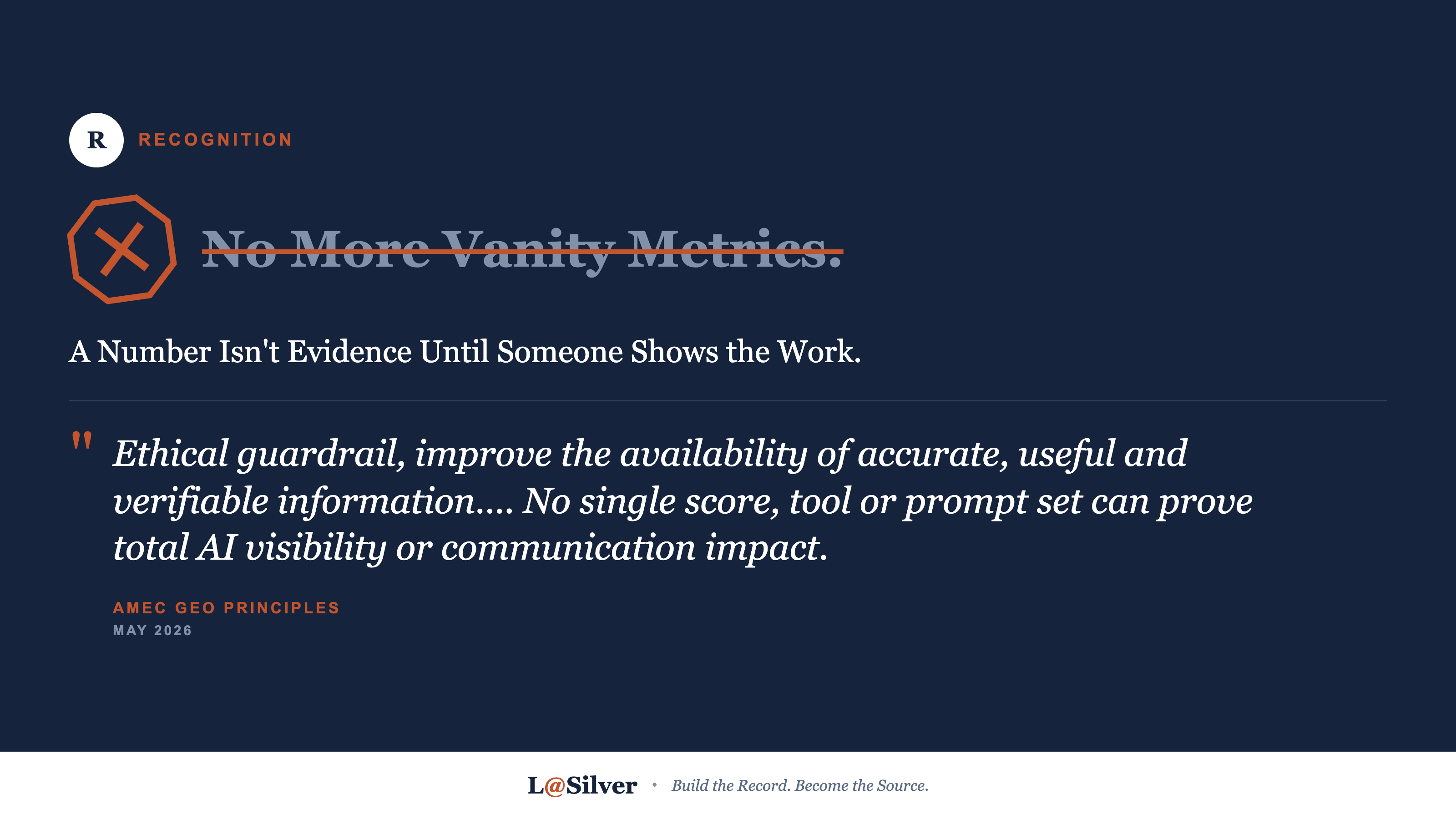
That’s most AI visibility scores right now. And I’m surprised our industry hasn’t dug deeper into this yet, because on May 20, 2026, AMEC, the group that sets the global standard for PR measurement, published new principles for measuring AI visibility. This is the first real answer, from the people whose job is measurement standards, on what a number has to prove before anyone should trust it. The rule: a number isn’t evidence unless someone can explain how they got it.
Can we talk about what’s actually happening here for a second?
Our industry is changing. PR and comms are finally getting pulled into THE room where decisions get made, and it’s well deserved. Brands started noticing they don’t show up when someone asks ChatGPT who to trust, and the answer to that lives in reputation, credibility, and authoritative coverage. Our domain. Nobody handed us a rulebook for it though. We’re writing it as we go.
That part is fun. Not the pressure of it. The actual figuring it out.
Every client and founder I talk to wants the same thing: get my score up (become part of the answer). I get why. It’s the natural question. But it’s the wrong first question, because a score is a mirror, not a roadmap.
So I rebuilt how I measure Recognition, the RECORD layer I’m covering this week.
Every audit starts with Spyglasses.io, a white labeled AI visibility platform built specifically for PR and marketing teams. I use it because it gives me a consistent way to see how ChatGPT, Gemini, Claude, Perplexity, and Google AI Overviews actually describe a brand, and just as important, the coverage and conversations shaping those results. I can see not just what AI is saying, but what’s influencing the answer. No guessing.
I then run those findings through the RECORD framework, layer by layer: Record, Expertise, Corroboration, Owned, Recognition, Documentation. Each layer produces a specific finding and a specific next step. Not just a score.
That’s the moment. The story stops being a number and starts becoming evidence.
Here’s what that looked like on a real audit. One client is an arts educator whose students land stage and screen roles. Nothing under his own name has been published in many many years. His site was never built for a machine to read. So I built him a new one.
The one piece of trade coverage built for exactly his category, a roundup of the elite experts to know and trust, profiled the studio he works out of. Not him.
That’s not a ranking problem. That’s a record that doesn’t exist, in the one place it needed to.
The method has to meet that same bar AMEC is setting. Every audit I run now documents which queries ran, on which platforms, on what dates, and states its own margin of error instead of presenting a number as exact. That’s the disclosure AMEC is asking for. In writing, not assumed.
A better AI score was never the goal. Getting the credits, the named programs, and a corrected, disambiguated identity actually documented somewhere AI and search can find, cite, and get right, is.
The mirror can keep ranking us. I’d rather build the thing it’s reflecting.
Build the Record. Become the Source.
____________________________________________________________________________
Sources: